The Anatomy of an AI Accelerator: Why the Chip Is the Business
May 26, 2026
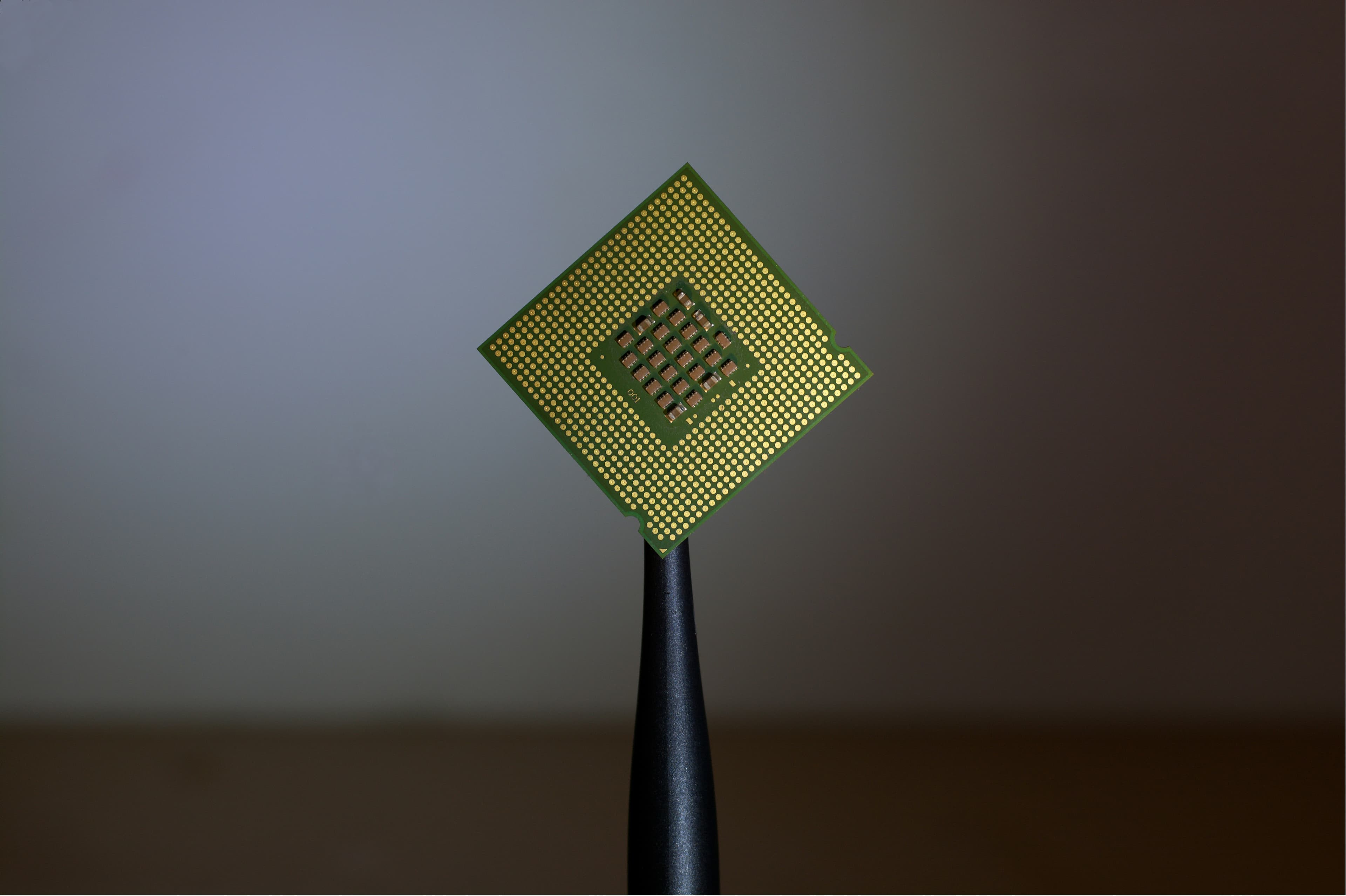
If you understand nothing else about accelerator design, understand that performance is governed by three constraints, and almost every competitive move maps to one of them: compute (how fast you can do the math), memory (how fast you can feed the math), and interconnect (how fast chips can talk to each other). Each has become a distinct commercial battleground. Compute and the precision trick Raw compute is measured in operations per second, but the more interesting story is precision. Numbers in a computer are stored with a certain number of bits, more bits means more accuracy but more cost in silicon, power, and time. The central insight of the last few years is that AI models often don't need much precision. A weight in a neural network can frequently be represented in 8 bits, or even 4, with little loss in quality. This matters enormously because halving precision can roughly double throughput and cut power per operation. When you see a vendor claim a new chip delivers "2.5x" the performance of its predecessor, a large part of that gain often comes not from a better manufacturing process but from supporting lower-precision number formats like FP4 (4-bit floating point). NVIDIA's forthcoming Rubin architecture, for instance, is reported to deliver up to 50 petaflops of FP4 compute on a single GPU roughly 2.5 times the prior Blackwell B200 generation. The lesson for an investor: headline performance numbers are partly a software and number-format story, not purely a fabrication story. Read them carefully. Memory: the real constraint Here is the counterintuitive part. The compute units are usually not the bottleneck. The bottleneck is feeding them. A tensor unit sitting idle while it waits for data is the most expensive idle asset in the building. Large models have hundreds of billions of parameters that must be shuttled to the compute units constantly, and ordinary memory simply cannot move data fast enough. The solution is High Bandwidth Memory (HBM), DRAM chips stacked vertically and placed directly beside the processor, connected by an extremely wide data path. The progression of this technology is now the single most important supply-side variable in the industry. The shift from the prior HBM3e generation to HBM4 doubles the interface width from 1,024 bits to 2,048 bits, enabling aggregate bandwidth on the order of 24 terabytes per second on a single next-generation GPU. Memory capacity per package is climbing toward 288–384 GB. The business consequence is profound and underappreciated: memory has stopped being a passive component and become a strategic chokepoint. HBM supply from the three makers, SK Hynix, Micron, and Samsung, is reported as fully allocated through 2026, with one supplier confirming its entire HBM4 capacity was sold out via advance contracts. When a component is sold out before it is made, pricing power shifts to the supplier. This is why the memory makers, long treated as cyclical commodity players, have become some of the most interesting names in the AI supply chain. HBM is an ever-larger share of the total bill of materials for an AI server. Interconnect: when the unit of compute becomes the rack A single chip, however powerful, cannot train a frontier model. Thousands must work as one. The speed at which they communicate determines whether you have a supercomputer or an expensive collection of separate computers. This is the interconnect battleground, and it is where the competitive moat has quietly widened. The strategic shift is that the meaningful "product" is no longer a chip, it is the rack, or even the data center, sold as an integrated system. NVIDIA's networking revenue reached a record $11 billion in a single quarter, up 263% year over year, driven by its NVLink fabric that lashes GPUs together, alongside its Ethernet and InfiniBand platforms. Notice what happened here: a "chip company" generated a networking business larger than most standalone networking companies, because it redefined the unit of sale. For a competitor, this raises the bar dramatically. You no longer need to beat one chip; you need to beat an entire integrated system and its software. The packaging revolution you can't see Now to the part of the story that is least visible to outsiders and arguably most decisive. Once you have a compute die and stacks of HBM, you must physically assemble them into a single package with connections dense enough to carry that 24-terabyte-per-second firehose. This is advanced packaging, and TSMC's CoWoS (Chip-on-Wafer-on-Substrate) is the dominant technology. CoWoS places the logic die and the HBM stacks on a single silicon interposer, think of it as an ultra-high-density circuit board made of silicon that allows them to communicate as if they were one chip. Without this step, a cutting-edge GPU is, quite literally, just a pile of unconnected dies. As one industry description put it, without CoWoS an advanced GPU is not a product at all. This creates the tightest bottleneck in the entire chain. TSMC has stated that demand for advanced-node wafers runs roughly three times its available capacity, and that CoWoS capacity has been sold out through 2025 and into 2026. The newest designs are moving to CoWoS-L and 3D-stacking techniques that vertically integrate logic and memory to cut the distance data travels and reduce power leakage. For investors, the packaging bottleneck explains several otherwise puzzling dynamics. It explains why TSMC plans capital expenditure of $52–56 billion in 2026, much of it for packaging that serves other companies' chips. It explains why the "GPU shortage" was often really a packaging shortage. And it explains why the competitive game is not won purely by chip design securing priority allocation of scarce packaging and memory capacity is itself a durable advantage.